
A seal on a supplement bottle looks like a guarantee. It is narrower than that. Each certification program checks a specific list of things and leaves others untouched, and the words "verified," "certified" and "tested" are not regulated terms on their own. This note explains what the main third-party programs say they check, what the FDA's role actually is, and how to read a seal without over-reading it. Everything below comes from the programs' and agencies' own public pages as of October 2026. Nothing here is medical advice; whether a supplement is right for you is a question for your doctor or pharmacist, not for a logo.
First, what the FDA does and does not do
The FDA's dietary supplements page is plain about the division of labour. "Manufacturers and distributors of dietary supplements and dietary ingredients are prohibited from marketing products that are adulterated or misbranded," and "these firms are responsible for evaluating the safety and labeling of their products before marketing." The agency "has the authority to take action against any adulterated or misbranded dietary supplement product after it reaches the market." Read those three sentences together: there is no pre-market approval step. A product can be on a shelf without anyone outside the company having checked what is in the bottle.
The NIH's National Center for Complementary and Integrative Health says the same thing from the consumer side: "the FDA is not authorized to review dietary supplements for safety and effectiveness before they are marketed." It adds a caution that applies directly to seals: "A manufacturer's use of the term 'standardized' (or 'verified' or 'certified') does not necessarily guarantee product quality or consistency." That is why the name of the organisation behind a seal matters more than the word printed on it. A brand can print "lab tested" on its own authority; it cannot print NSF's or USP's mark without that organisation's program behind it.
NSF Certified for Sport: built for drug-tested athletes
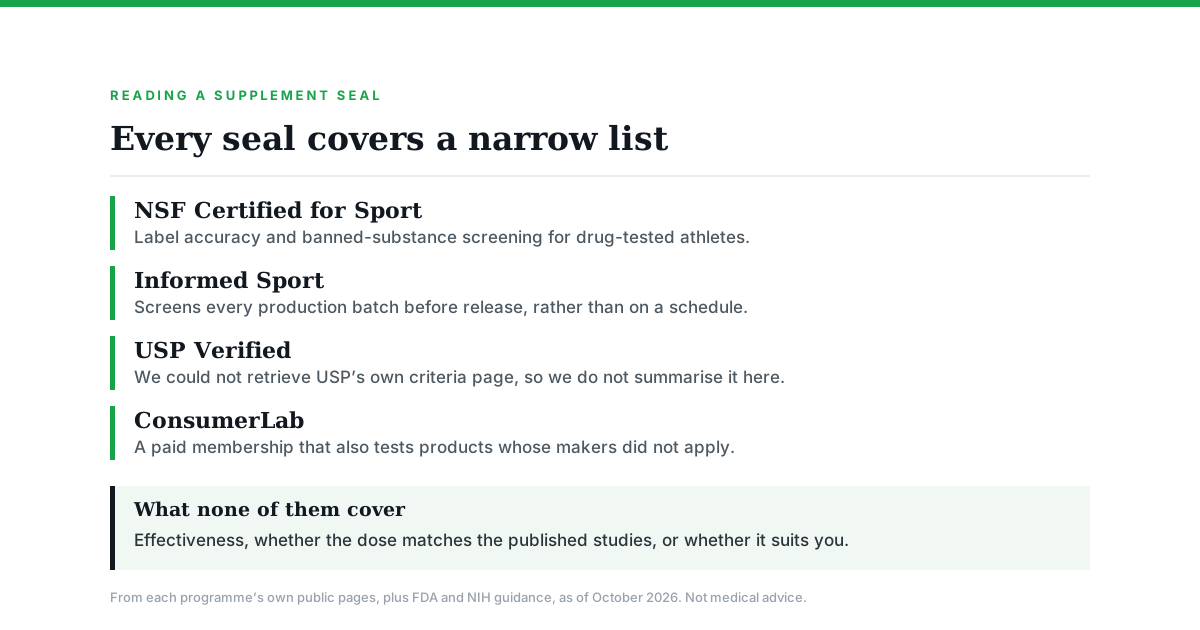
NSF's Certified for Sport program is the one most often cited by professional leagues. As of October 2026 its site describes the mark as recognised by USADA, MLB, the NHL and the CFL, and a product feature on the same site states the item was "tested for 280+ banned substances." The program's scope is contamination and label accuracy for athletes who face anti-doping tests; its value is highest for someone who could lose a season over a trace of a prohibited stimulant. For a recreational buyer, the relevant part is simpler: a product carrying the mark has had its contents checked by someone other than the brand.
What the mark does not do is rank effectiveness or dosage. A certified product can contain an ingredient with weak evidence behind it, at a dose below what the published studies used. The seal answers "is what is on the label in the bottle, without banned contaminants?" and nothing else. It also says nothing about whether the product is appropriate for a particular person, which remains a question for a clinician. Our Optimum Nutrition creatine review and Gold Standard Whey review note where a product carries a third-party mark and keep that separate from the evidence grade for the ingredient itself.
Informed Sport: the every-batch model
Informed Sport, run by the laboratory group LGC, states its core promise in three words on its homepage: "EVERY BATCH. TESTED." The program screens each production batch before release rather than certifying a product once and re-checking on a schedule. As of October 2026 the site reports "over 2000" certified products from "330+ brands" sold in "132 countries," and cites an estimate that "one-in-ten supplements" may be contaminated with prohibited substances. That one-in-ten figure is the program's own framing of the problem it exists to address; it is not a measurement of any specific product or brand.
The practical difference between a per-batch program and a periodic one is what happens between tests. If a raw-material supplier changes mid-year, a periodic program might not catch it until the next scheduled sample; a per-batch program is designed to catch it in that lot. Whether that matters to you depends on how much you care about lot-to-lot consistency versus the general reputation of a brand. The Informed Sport homepage does not publish the number of substances on its screening panel; the certified product's own page usually does, and it is worth reading that figure there rather than assuming it matches another program's.
USP Verified and ConsumerLab: two different models
The USP Verified Mark comes from the United States Pharmacopeia, the body that writes quality standards for medicines sold in the United States. We were unable to retrieve USP's own program page while preparing this note, so we will not paraphrase its criteria from memory; check usp.org or its consumer site, quality-supplements.org, for the current list. What can be said from brand pages is that USP verification is common on mainstream vitamin lines, and that the mark concerns identity, amount and contaminants rather than whether the ingredient works for the purpose on the front of the bottle.
ConsumerLab works differently. As of October 2026 its homepage describes it as a membership service - "Join over 100,000 members and access 1,400+ product reviews" - that tests products it selects and publishes pass or fail results behind a paywall. Brands that pass can license a ConsumerLab seal through its "Quality Certification Program." The useful distinction: USP, NSF and Informed Sport are programs a brand applies to and pays for; ConsumerLab also tests products that did not ask to be tested. Neither model is wrong, but they answer slightly different questions, and a product with no seal has not necessarily failed anything. It may simply never have applied.
How to read a seal in thirty seconds
Find the organisation's name, not just the word "certified." Look for a lot number near the seal; per-batch programs tie the certification to that lot, and the brand's site usually lets you search it. Check whether the seal is on the product itself or only in the brand's marketing; some brands certify a few flagship products and let the halo spread across the range. Then set the seal aside and read the Supplement Facts panel for the dose per serving, because no certification program grades whether that dose matches the research. For a short list of ingredients where the evidence is strongest, see our guide to supplements with the best evidence.
Bottom line
A third-party seal is a statement that someone outside the company checked identity and contaminants, and in the sports programs, banned substances. It is not a statement about effectiveness, dose or whether the product suits you. The FDA does not pre-approve supplements, so these programs are the closest thing to an outside check most products get, which makes them worth looking for. Read the organisation's name, look for a lot number, and keep the seal in its lane. For anything that touches your health, your medications or a medical condition, the NIH's advice stands: talk with your health care providers about any supplements you use.
Community discussion
Enjoyed this story? Share your thoughts below.